
Materials & comparisons
Choosing flooring underlay for sound, support and compatibility
The right layer is the one approved for the whole floor assembly.
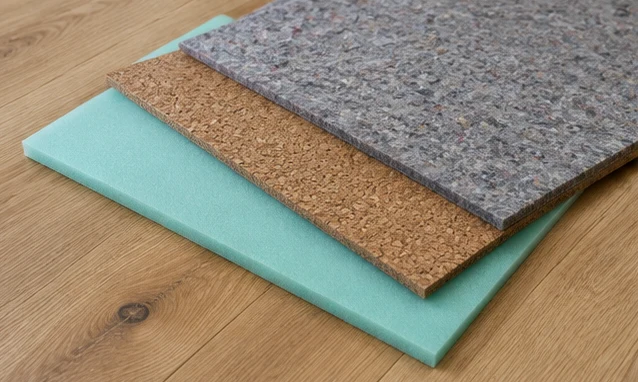
Underlay is often chosen after the boards, from a shelf of products promising comfort or quieter footsteps. For a floating laminate or engineered floor, it is part of the working assembly rather than an optional cushion. It must support the joints while meeting the floor's requirements for moisture protection, sound and, where relevant, heat transfer. More thickness is not automatically better, and a product suitable beneath one covering may be wrong beneath another. This guide focuses on selecting that layer, not on repairing or levelling the structure below it.
Check whether separate underlay belongs there
Start with the exact flooring instructions. Floating products commonly specify an underlay, but some boards already have an attached layer. Do not add a second cushion unless the manufacturer expressly permits that combination. Additional compression can change how joints behave and may take the assembly outside its tested or approved specification.
Full-bond engineered flooring is a different system. Ordinary loose underlay does not belong between adhesive and timber simply because it is sold for wood floors. A specialist bonded acoustic layer may be possible where the complete system is approved. Likewise, carpet underlay and products intended for resilient click flooring are not interchangeable with laminate accessories. Write down the permitted underlay type before comparing marketing descriptions, and resolve any uncertainty with the flooring supplier rather than guessing from the roll's appearance.
Prioritise support over a soft first impression
A floating floor transfers loads through its boards and joints. The underlay needs the support characteristics specified for those connections, including how it responds to repeated use and sustained furniture loads. A soft sample that feels pleasant when squeezed may not give a locking edge the support its designer intended.
Ask for the technical data sheet and compare it with the flooring manufacturer's requirements. Thickness, compressive behaviour and long-term performance are more useful than colour or a vague description such as premium. Do not double layers to make the floor feel luxurious or to raise it towards an adjoining tile. Too much movement can stress joints. Finished-height differences should be designed at the transition, not improvised by changing the support beneath part of the room.
Name the sound problem you want to address
There are two distinct experiences to consider: the sound of walking heard within the room and impact sound transmitted into the construction and neighbouring spaces. A product can be promoted strongly for one without being the best choice for the other. Decide whether the priority is a hollow footfall beside the sofa or disturbance in a room below.
Read what a published test actually covers. Values from different tests, substrates or complete assemblies may not support a simple better-or-worse ranking. An underlay label is not a guarantee of what a neighbour will hear in a particular building. In a flat, check the lease and any approval requirements before buying the floor. If evidence of performance is requested, ask what complete construction and documentation will be accepted rather than sending only a retail specification.
Separate moisture protection from cushioning
Some underlays incorporate a vapour-control layer; others need a separate component where the flooring specification calls for one. The substrate and complete build-up determine the correct arrangement. Do not assume that foil colouring means an effective moisture barrier, or that every timber-based floor needs the same membrane as a mineral base.
Check the required treatment at seams, edges and penetrations. A protective layer is only as continuous as its installed detail. Follow the specified tape and joint arrangement rather than overlapping everything indiscriminately. Conversely, do not introduce an impermeable layer into a timber construction without checking whether it is appropriate. Underlay cannot make an unresolved damp problem suitable for flooring: establish moisture conditions and the approved protection strategy before selecting the final accessory.
Check heating and finished height together
With underfloor heating, the combined thermal resistance of the floor and underlay matters. Select against the requirements of both suppliers, not an isolated low-tog claim. An underlay intended to insulate a cold room may oppose the intended transfer of heat from below. Compatibility with one heating arrangement also does not establish suitability for every electric or water-based system.
Calculate the finished assembly at doorways, appliance spaces and adjoining floors. Board thickness, underlay, membranes and any other specified layers all contribute. A thinner approved product might simplify a threshold, but reducing support or omitting moisture protection to gain clearance is not a sound compromise. Check the door swing and transitions before fitting, while there is still an opportunity to choose a suitable detail rather than force the last layer to solve everything.
Buy and install the specified layer consistently
Once the product is selected, retain its name and technical sheet with the flooring paperwork. Similar-looking rolls can have different functions. Check that the supplied material matches the approved choice and that the quantity includes the actual rooms and necessary detailing, not just a rough area calculated from furniture-free space.
Installation should follow the underlay and flooring instructions together. Seams, orientation and tapes vary by product; edges that overlap unintentionally can form ridges beneath the boards. Keep the surface clean and avoid leaving debris between layers. Do not patch a shortage with unrelated scraps or introduce extra layers in one corner. A consistent, compatible assembly is the goal. The finished floor should not rely on an accessory being asked to conceal a problem it was never designed to correct.
Questions we're asked about this
Choose the underlay alongside the floor
Provide the board specification, substrate type and any heating or acoustic requirements to discuss a compatible assembly before ordering rolls and accessories.
Get a free quote
Reply within 24 hours - No obligation