
Problems & repairs
Fitted drawer runners: fixing sticking drawers and choosing replacements
Start with the drawer box and opening before blaming the soft-close unit.
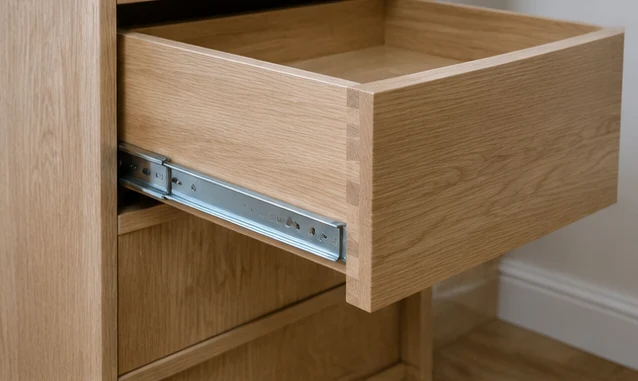
A drawer that needs a sideways tug every morning is telling you something about its alignment, loading or mechanism. Changing the runners can help, but not if the cabinet has twisted or the drawer bottom is dragging underneath. Fitted drawers also have clearances built into their construction: a replacement slide that looks similar may demand a different box width or a special underside connection. Diagnose the movement first, then identify the hardware. This approach preserves usable joinery and avoids ordering a fashionable mechanism that cannot fit the existing drawer without rebuilding it.
Describe exactly when the drawer sticks
Empty the affected drawer and remove anything protruding behind or beneath it. Compare its action with a neighbouring drawer without swapping components. Does it catch immediately, bind halfway out, or resist only during the last part of closing? Note whether lifting the handle changes the movement, but do not use that as a permanent workaround.
A fault that disappears when the drawer is empty may relate to overloading, a sagging base or runners working beyond their intended capacity. A repeated scrape at one position suggests a local obstruction or proud fixing. Resistance at the final closing stage may involve the soft-close catch, although misalignment can prevent a healthy catch from engaging correctly.
Check the box and cabinet before the slides
Look for a loose drawer front, separated joints or a base that has slipped from its groove. A bowed base may rub on the rail or drawer below. The cabinet opening also needs to remain square enough for the mechanism: twisting introduced by uneven support or over-tightened wall fixings can make parallel runners converge.
The repairer should check both runners for level, matching setback and parallel positioning. A screw head standing above its intended recess can obstruct moving sections. Loose screws need a sound fixing repair rather than being tightened repeatedly into a worn hole. Do not pull a loaded drawer out further to inspect it if you do not know how its release or stops operate.
Recognise a worn or broken mechanism
Ball-bearing runners can become rough when bearing cages distort or parts are lost. Roller slides may develop damaged wheels, while concealed undermount systems can suffer broken locking clips or adjustment fittings. A failed soft-close damper is a different component from the runner that supports the drawer, although some products combine them in a single assembly.
Where the manufacturer supplies a separate damper or catch, replacing that part may be enough. Bent rails, missing bearings and cracked load-bearing components should not be disguised with lubricant. Check the drawer release instructions before removal and support the box during handling. An apparently light front can conceal a deep drawer that becomes difficult to control when detached.
Choose mechanisms by fit, travel and load
Side-mounted slides occupy space between the box and cabinet; undermount runners generally need particular underside details, locking devices and clearances. Simple roller runners use another arrangement again. Converting between families may mean altering the drawer box rather than exchanging two metal strips. Confirm the dimensional requirements from the exact product drawing.
Decide whether the drawer needs partial or full extension, allowing for handles and nearby doors when open. Check the stated load rating and how the manufacturer defines it, including whether the drawer’s own weight counts. Deep drawers holding dense contents need particular care. A higher rating does not compensate for weak cabinet sides or badly positioned fixings.
Treat soft-close and push-to-open as systems
Soft-close describes the controlled final closing action, not the strength of the whole drawer. Push-to-open needs suitable clearances and an arrangement that releases reliably when the front is pressed. Some products combine these functions; others do not. Specify the desired operation explicitly instead of assuming either feature can be added to any runner.
Replacement runners are normally selected and installed as a matched left and right set. Retain the identification of any clips, catches and brackets that belong with them. If a repairer proposes reusing one old runner alongside one new one, ask for confirmation that the manufacturer supports that combination. Different travel or closing behaviour can rack the drawer during use.
Check the completed repair with realistic contents
Photograph the mechanism markings before searching for replacements online. Retail descriptions such as heavy duty or universal do not establish matching hole positions, closed length or installation clearance. Check whether a quoted runner length refers to the same measurement used by the original maker. Also measure the usable cabinet depth, allowing for the back and any services rather than assuming it equals the external depth. Bring those details together before ordering. Retaining a sound drawer front is often possible, but any alteration to the box needs to preserve its joints and the way the front is attached.
Test the drawer empty first, watching the front gaps and checking that it clears adjacent handles. Then reload it sensibly and test normal travel again. The box should not scrape, drop abruptly or need lifting to close. Make sure release clips are fully engaged and that stops work as intended.
Keep the product reference and any adjustment instructions. Ask which cleaning method and lubricant, if any, the manufacturer permits; indiscriminate sprays can attract debris or affect plastic parts. If the drawer is intended for unusually heavy contents, agree that use before replacement hardware is chosen. A clear brief about what sticks, when it started and what the drawer holds is more useful than requesting soft-close runners alone.
Questions we're asked about this
Have a fitted drawer that will not run properly?
Describe where it catches and send clear photographs of the drawer side, underside and any hardware markings.
Get a free quote
Reply within 24 hours - No obligation