
Problems & repairs
Gate wind loading: planning for an exposed entrance
A privacy screen becomes a moving load when it is hung on hinges.
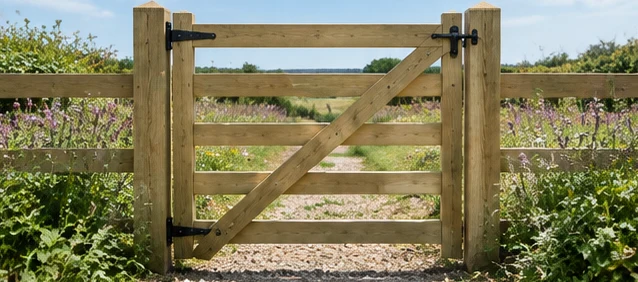
An exposed gate can be difficult to control even when its timber is sound and its hinges are new. Wind pushes on the leaf, changes the force needed to move it and can accelerate it towards a stop or a person. The solution is not simply a larger latch. This guide explains what belongs in a safe structural brief for an exposed entrance, without offering universal post sizes, footing depths or wind speed limits that ignore the site.
Identify exposure before selecting the leaf
Start with the entrance surroundings. A gate at the end of an open approach experiences different conditions from one sheltered within a continuous boundary. Gaps between buildings can also create gusty conditions, so a narrow passage is not proof of shelter. Describe what happens during strong wind, including whether the leaf is pushed open, pulled from a holdback or slammed shut.
Record the leaf dimensions, boarding arrangement and opening direction, along with nearby walls and fences. Photographs taken from each approach help explain the setting. Do not test a troublesome gate during a storm to demonstrate the problem. If it is already difficult to restrain safely, keep clear and arrange for it to be assessed. Observations from normal use are enough to identify the need for a more careful specification; they are not a substitute for calculating structural loads where required.
Understand what solidity changes
A close boarded leaf presents a substantial area to the wind. An open arrangement can allow some air through, but its performance depends on the gaps and the overall geometry. Calling a gate slatted does not establish a reliable load reduction. Airflow is more complicated than subtracting the visible gaps from the face area and reducing every component by the same fraction.
Adding sheets, mesh, screening or closely spaced boards to an existing open gate changes the brief. The hinges and posts may have been chosen for the original arrangement, and the extra material adds weight as well as changing wind effects. Treat a privacy conversion as an alteration to a moving structure rather than a decorative attachment. Ask whether the retained frame and support system can accept it before buying the infill, particularly where the entrance already behaves badly in gusts.
Follow the forces through the whole support
Wind force on the leaf has to pass through its frame and hinge connections into the post and foundation. A substantial post cannot compensate for a weak hinge fixing, and stronger hinges do not improve loose ground or cracked masonry. Each connection is part of the same load path. That is why a local hardware upgrade may leave the underlying risk unchanged.
The assessment should cover gate area and weight, leverage from the hinge line, exposure, support height and foundation conditions. Where masonry carries the hinges, the wall's condition and capacity matter as much as the chosen anchor. Do not assume that a neighbouring fence post or thin garden wall is suitable because it has not yet failed. For large, heavy or unusually exposed leaves, obtain a design from a suitably competent specialist, with structural input where needed, instead of scaling up a small gate detail by eye.
Design for open and closed positions
A gate is not only loaded when it is shut. An open leaf can swing violently, and a holdback may receive a substantial force when the wind changes. A closed gate also needs an appropriate stop so that its latch or lock is not the only part resisting repeated impacts. Review the intended resting positions and the forces in each.
Choose purpose made stops and holdbacks suited to the gate and their supporting construction. Check that their positions do not introduce a trip hazard or a pinch point during ordinary access. An improvised rope, loose brick or light cabin hook should not be treated as an engineered restraint for an exposed heavy leaf. A closer or damper may influence movement, but its manufacturer must confirm suitability for the actual gate and conditions. It does not remove the need for adequate structure and safe clearances.
Keep automation outside a casual alteration
Powered gates need a coordinated safety assessment. Changing the boarding, leaf size, hinges or operating hardware can alter both structural loads and the way the powered system responds. A motor described as more powerful is not a safety solution to a gate that catches the wind. Increased driving force can introduce other hazards if the complete installation is not assessed.
HSE's powered gate guidance specifically includes wind effects, mounting stability, foundations and dynamic forces within safe design considerations. It also stresses that safety depends on the assembled system, not simply its individual components. If an exposed gate is powered, use a competent powered gate specialist for alterations and subsequent verification. Do not transfer a manual gate repair proposal directly onto it, and do not disable protective devices because gusts cause inconvenient operation. The cause needs investigation within the complete system.
Ask for a specification with stated assumptions
A useful proposal explains what gate configuration it covers, what supports are being retained, and how the leaf will be restrained in normal positions. It should make clear whether foundation investigation or structural advice remains outstanding. Without those assumptions, a neat drawing of a thick post tells you little about the adequacy of the entrance.
Discuss practical operation as well as resistance to failure. An entrance can remain standing while still being unpleasant or unsafe to handle in gusty weather. Reducing the leaf area, changing the opening arrangement or reconsidering the desired privacy may be more sensible than endlessly strengthening the same design. Any revised layout needs its own assessment of access and trapping risks. The objective is a controllable entrance with a coherent support and restraint system, not a promise that it can be used normally in every weather condition.
Questions we're asked about this
Describe the exposure before choosing a gate
For an exposed entrance enquiry, include the leaf dimensions, boarding layout, support photographs and a description of its behaviour in gusts. Do not approach an uncontrolled leaf to obtain images.
Get a free quote
Reply within 24 hours - No obligation