
Problems & repairs
Replacing a timber gate post while retaining the gate
Preserve the useful leaf without copying the failed support.
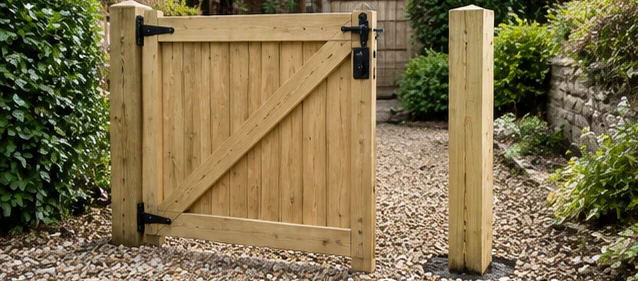
A failed hanging post does not automatically make a sound timber gate redundant. The leaf may still be square, its joints firm and its boards serviceable. Retaining it changes the repair brief: the new support must suit an existing gate and hardware arrangement, not a fresh opening designed from scratch. Once post failure has been established, the important questions are what can be reused, how the entrance will be secured during work, and what the ground can safely support.
Record the retained gate before dismantling
Photograph both faces with the gate closed and open. Record its width, height and thickness, together with the hinge positions, hinge pin arrangement and closed clearances. Note where the latch engages and whether any existing stop belongs to the post being removed. These details establish the geometry that the replacement has to reproduce or deliberately improve.
Inspect the leaf itself before committing to retention. Sound boards alone do not prove that the hinge stile or rail joints can carry the gate again. Look for splits around fasteners, opened joints and damaged hinge mounting areas. Separate cosmetic wear from loss of useful fixing timber. A gate that needs extensive frame rebuilding as well as a post may warrant a different scope. Retention is worthwhile when it preserves a serviceable component, not when it avoids discussing hidden damage.
Plan removal without leaving a suspended load
The gate must be safely supported and removed before the post is disturbed. Heavy or awkward leaves need suitable lifting equipment or a planned assisted lift, not an improvised prop while concrete is broken out. Keep the working area clear and do not leave a partly detached leaf leaning where it can fall into the route.
Decide how the opening will be managed between removal and rehanging. Temporary barriers may be needed for security or to keep animals away from excavation, but they must not obstruct an essential access route. If the post also supports fencing, that connection needs separate temporary support before it is released. Record which fittings belong to which position and protect reusable hinge pins and threads. The aim is controlled dismantling, with no reliance on a weakened post to remain stable during the work.
Investigate the old foundation and buried services
Removing a post often means dealing with an old concrete footing, not merely lifting timber from soil. Its extent may be unclear until exposed. Nearby paving, drains, wall foundations and buried utilities can limit the available working space. Do not assume that a familiar garden corner is free of services or that a previous installer checked their route.
HSE guidance on excavation identifies planning, locating and identifying underground services, and safe excavation as the core precautions. Apply that approach before digging or breaking material around the footing. Where services or adjoining structures make removal uncertain, the method needs competent assessment. Leaving old concrete in place and forcing a smaller post into the remaining pocket is not automatically acceptable. The proposed support must work as a complete foundation arrangement, whether the old material is removed or incorporated following a suitable design.
Specify the new support for the actual load
A replacement post must resist the retained gate's weight, its leverage and the wind acting on it. Width matters because the leaf projects away from the support; height and openness affect exposure. Ground conditions and the foundation arrangement matter too. There is no single post section or embedment depth that can be responsibly prescribed for every retained gate.
Choose timber treatment suitable for the intended exposure, including ground contact where relevant, and follow the post and treatment supplier's instructions for cuts and drilled areas. Plan drainage so the new detail does not create a persistent water pocket. A generic light duty post shoe is not necessarily designed for the bending loads of a hanging gate. If a proprietary anchor or alternative support is proposed, its stated application and the substrate capacity must match the job, rather than merely matching the post dimensions.
Recreate the hinge line, not every old defect
Set out the hinge line against the retained leaf and the latch post, allowing the clearances required by the gate and hardware. Reproducing the old post position exactly may reproduce a crooked installation. Conversely, moving it casually can leave the gate too narrow for the opening or push the latch beyond its useful adjustment.
Check reusable hinges for distortion, excessive wear and damage around their fixings. Their spacing and attachment must still suit the leaf. Do not assume every old screw can be reused simply because the metal looks clean. When the foundation uses concrete or another setting product, respect the stated loading and curing requirements before rehanging. A surface that appears hard is not evidence that the support is ready for the gate's leverage. Keep the temporary arrangement in place until the specified installation sequence is complete.
Check the retained leaf as a working assembly
After rehanging, check the clearances through the full swing, not just with the gate closed. The gate should meet its stop and latch without being lifted or forced. Confirm that the hinges remain properly engaged and that any retaining features are installed as intended. A new post should not make the old lock carry closing impacts it was never designed to resist.
Agree the finishing boundary: disturbed paving, fence connections, exposed timber surfaces and any relocated latch fixings should all be accounted for. Keep photographs of the exposed foundation and the installed support before the area is closed up. They provide a useful record of what was actually replaced. If the retained gate now reveals a separate frame defect, discuss that explicitly rather than quietly trimming away timber to make a post replacement appear complete.
Questions we're asked about this
Retain the gate, replace the failed support
For a post replacement assessment, provide the gate dimensions and photographs of its hinges, the post base and the surrounding paving or fence connections.
Get a free quote
Reply within 24 hours - No obligation