
Problems & repairs
Side gate locks and latches: making security usable
Plan how the entrance opens from both sides before choosing hardware.
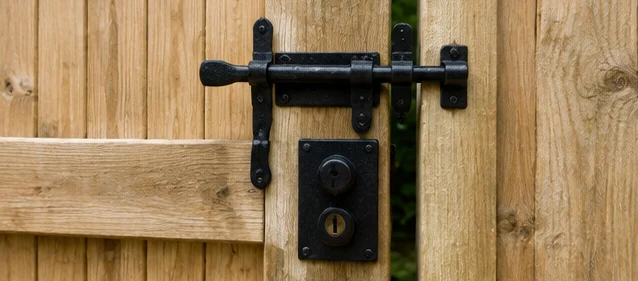
A side entrance can be secure when locked yet awkward every time it is used. A padlock may require a key from the garden, a latch may be reachable over the top, or a keypad may fit the gate but foul the wall. Choosing hardware means resolving those details together. This guide concerns ordinary manually operated timber side gates: the latch, lock, keep and release arrangements, rather than selecting a gate style or diagnosing a damaged structure.
Separate closing, locking and holding open
A latch holds the gate closed during ordinary use; a lock restricts who can release it. Some products combine these functions, while a separate bolt and padlock add locking to an otherwise simple latch. A holdback has another job: keeping an open leaf from swinging unexpectedly. Treating one component as a substitute for all three leads to awkward operation and avoidable damage.
Write down what should happen when the gate is pushed shut. Should it latch without being locked, or prevent entry immediately? Automatic relocking can be useful, but it can also leave a key inside the house while the entrance locks behind you. Decide that behaviour deliberately, including how access is recovered. A lock should not be selected simply because its case looks substantial; its operation must suit the route and the gate construction.
Map access from each side
Consider the entrance in both directions. A key cylinder outside with an internal handle behaves differently from a lock requiring a key on both faces. A coded release avoids distributing keys but introduces code management and, on some models, a separate internal release. Check the actual model instructions: similar looking keypads need not have identical functions or handing.
Any required escape route needs an appropriate access arrangement assessed before adding a lock. Do not assume that a side gate is irrelevant merely because it is outdoors. Equally, a release reachable through a gap may undermine the security you intended. The answer is a coordinated layout, not making exit unnecessarily difficult. Test the proposed handle position with shopping or a bicycle in mind, and check that fingers have room between the handle, post and neighbouring wall.
Measure the mounting area, not just gate thickness
Hardware needs a sound fixing zone. Note the thickness and width of the stile or rail that will carry it, the closed gap beside the post, and the space available for the keep. Thin boarding is not equivalent to a structural rail. A lock fitted neatly to flexible boards may move enough to misalign its bolt whenever the gate is pushed.
Record the opening direction and which face receives the lock body. Check handle travel throughout the swing, including any projecting cylinder or padlock. Manufacturer drilling templates and stated gate thickness ranges matter here; dimensions from a different lock cannot safely be borrowed. For example, Gatemaster supplies model specific spindle and fixing arrangements for its timber gate locks. Establish compatibility before cutting a mortice or drilling through finished timber, because those alterations cannot simply be undone.
Allow engagement without forcing the leaf
The bolt or latch must enter its keep by the amount specified for that product. Too little engagement weakens the closed arrangement; a bolt rubbing hard against the keep makes unlocking difficult. A lock should operate without lifting, pulling or twisting the gate into position. If the leaf needs that help, resolve its support or alignment before using new hardware to disguise it.
Outdoor timber movement also needs consideration. An adjustable keep can help with small changes, but only within the manufacturer's limits and without reducing engagement below the required amount. Do not file away a large opening on the assumption that more clearance is always better. Check the operation with the leaf resting naturally against its stop. Then confirm that closing pressure is taken by the intended stop, rather than being repeatedly delivered into a small lock case or unsupported keep.
Look at the complete security arrangement
A strong lock attached to weakened timber is a weak installation. Assess the fixings, post, hinge attachment and surrounding boundary alongside the lock itself. Exposed removable fixings or a release accessible through a nearby opening can defeat an otherwise sensible choice. Security comes from how the parts work together, not a single component described as heavy duty.
Select hardware intended for external use and follow its instructions on compatible fixings and corrosion protection. Mixing metals or using unsuitable screws can create problems that appear only after weathering. If an insurer specifies a particular locking arrangement, obtain the requirement in writing and check the proposed product against it. Avoid treating a general marketing description as proof of insurance acceptance. Where there is a specific security risk, get advice on the full entrance rather than adding successive bolts to the same vulnerable timber.
Agree the handover tests before fitting
A useful fitting brief states the desired locked and unlocked behaviour, who needs access, and which side must offer release without a key. Include any requirement for deliveries or garden equipment to pass. That information narrows the choice much more effectively than a photograph of an attractive handle alone.
At completion, operate the gate from both sides through several normal opening and closing cycles. Confirm that the latch catches, the lock releases without pressure on the leaf, and keys or codes perform exactly as expected. Check that the gate can be held open using a suitable purpose made arrangement where needed. Keep the product identification and instructions with the access information, but store codes and spare keys securely. These checks concern function at handover; they do not turn an unsuitable boundary into a secure one.
Questions we're asked about this
Plan a side entrance that works from both sides
For a gate hardware enquiry, include photographs of both faces, the closed gap and the available mounting timber, plus the release behaviour you need.
Get a free quote
Reply within 24 hours - No obligation