
Costs & quotes
Skirting board prices: what actually changes the fitted cost
Why the price per length on a shelf tells you little about the cost of a finished room.
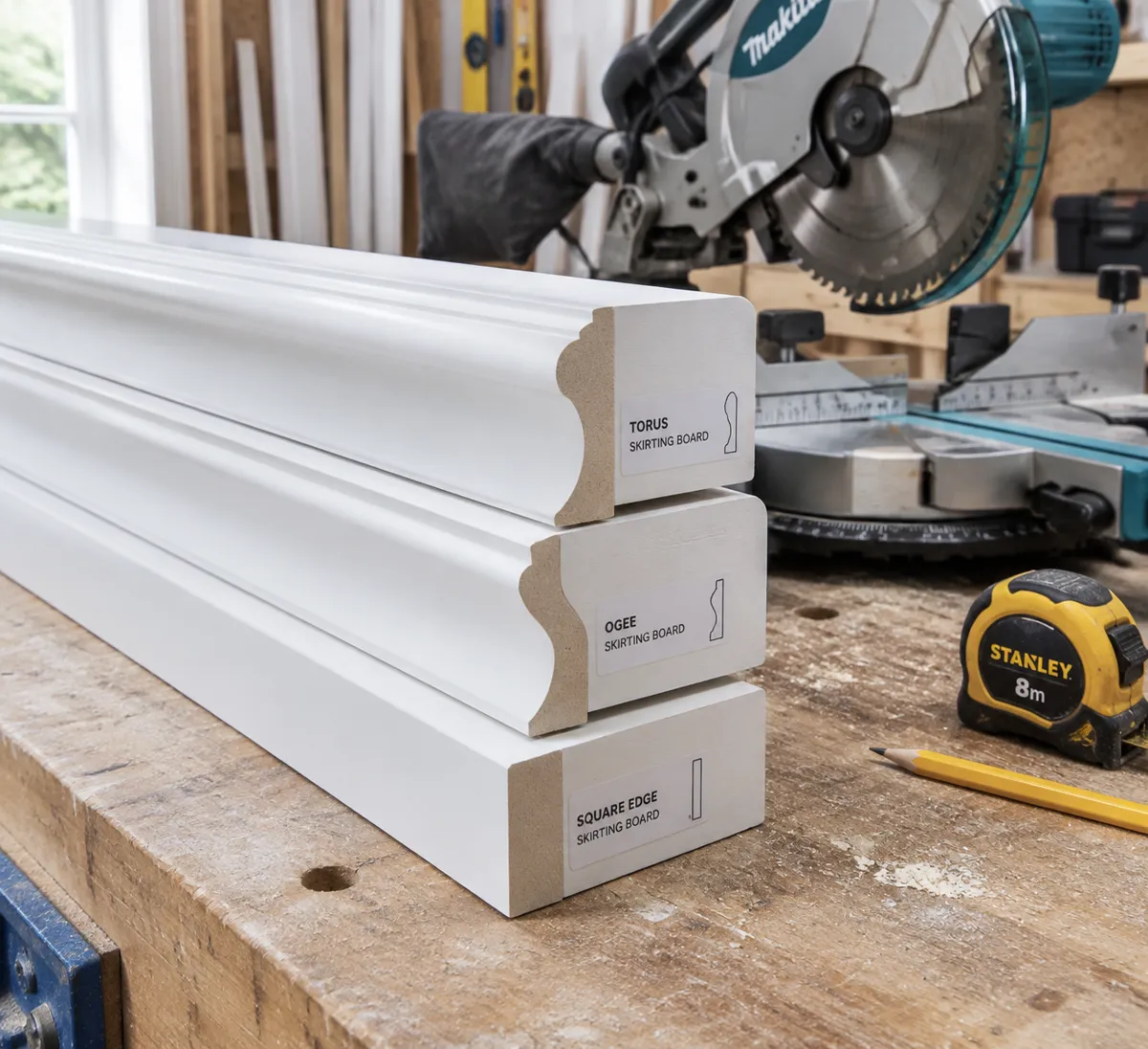
Search for skirting board prices and you will find lengths of moulding listed by the metre, which makes the job sound easy to budget. The board is rarely the expensive part. What decides the finished cost of a room is how many internal and external corners it has, how flat the walls are, whether old skirting has to come off cleanly and what happens to the decoration afterwards. This guide sets out those cost factors so that two quotes can be compared fairly, and so you know which choices raise the figure and which hardly move it.
Material: MDF, softwood and hardwood
Primed MDF is the usual choice for painted skirting. It is stable, comes in long lengths and takes paint cleanly, which keeps material costs and preparation time down. Softwood such as redwood is preferred by some for its toughness at the bottom edge and in period houses, but it needs knotting and more filling before painting.
Oak and other hardwoods cost considerably more per length and are less forgiving to fit, because every joint is visible under a clear finish. Waste allowance is higher too, since boards with poor grain or splits are rejected. If you want oak, budget for both the board and the extra care in jointing.
Profile and height
Simple profiles such as pencil round or chamfered are quick to cut and join. Ornate profiles like ogee and torus take longer, because internal corners are normally scribed rather than mitred so they stay closed as the house moves. A deep period skirting may also need to be built up from two pieces.
Height affects more than material. Taller boards show every undulation in the wall and floor, so they take longer to fit tightly, and they are heavier to fix. Matching an existing historic profile may involve having a run machined, which adds a separate cost and lead time.
The room itself
A plain rectangular bedroom has four internal corners. A hallway with door openings, a staircase string, radiator pipes and a bay window can have twenty or more joints in the same length of wall. Each one is a cut that has to fit, and that is where most of the time goes.
Wall condition matters as well. Bowed plaster may need the board scribed or the wall packed so it sits tight without a large caulk line. Uneven floors require the bottom edge scribed if there is no carpet to hide a gap.
- Number of internal and external corners
- Door openings, pipes and radiators to work around
- Flatness of walls and floors
- Whether old skirting is removed and plaster repaired
Removal, making good and decorating
Taking off old skirting can pull away plaster, especially in older homes where the board was fixed before the wall was finished. Patching that is a separate task and should be priced explicitly. Ask whether the quote includes removal and disposal of the old boards.
Painting is often excluded from a carpentry price. Filling nail holes, caulking the top edge and applying two coats is a meaningful amount of work across a whole floor. Be clear who is doing it, because unpainted skirting left for weeks also picks up marks and moisture.
Timing alongside flooring
If new flooring is planned, the order of work affects price. Fitting skirting after a wood or laminate floor lets the board cover the expansion gap without separate beading, which usually looks better and avoids a second visit. Fitting before carpet is normal, with the board set slightly above the bare floor.
Combining the two trades or having one carpenter do both can save repeated set-up time, but only if the floor is actually ready when the carpenter arrives.
Comparing quotes fairly
A useful quote states the material, profile and height, the rooms included, whether removal and disposal are covered, how corners will be joined and whether finishing is included. If one price looks much lower, it is usually because one of those items has been left out rather than because the work is quicker.
Send room sizes, photographs of existing skirting and corners, and the profile you like. That lets a carpenter quote accurately without guessing the number of joints.
Period homes and matching existing runs
In older houses the challenge is often matching what is already there rather than choosing something new. A replacement length in one room has to meet the original profile in the hall, and off-the-shelf mouldings rarely match exactly in height, thickness or the shape of the top edge. The usual options are finding the closest stock profile and accepting a slight difference at a doorway, building up a match from two simpler mouldings, or having a short run machined to a template cut from an existing board.
Old skirting is also frequently fixed to timber grounds or wedges set into the masonry rather than to modern plaster. When those grounds have rotted or come loose, they need replacing before new boards can be fixed straight, and that adds time which is easy to miss on a first look. A carpenter who lifts a small section during the survey can usually tell you whether this is likely. Lime plaster behind the board may crumble when disturbed, so allow for some patching and drying time before decorating starts.
Questions we're asked about this
Pricing new skirting?
Send us room sizes, photos of the corners and the profile you want, and we will give you a clear written quote.
Get a free quote
Reply within 24 hours - No obligation