
Problems & repairs
Matching existing timber mouldings during a partial repair
An accurate replacement starts with evidence of the original section.
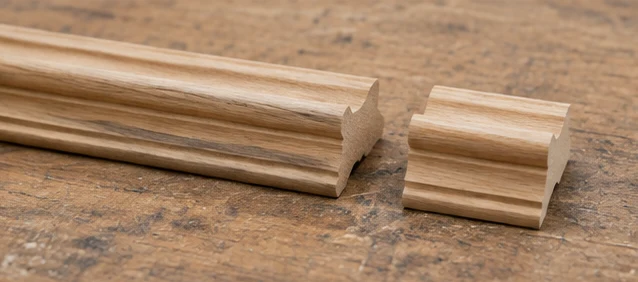
A short missing length of trim can stall a repair when nothing in a current catalogue quite matches. Similar names and photographs are unreliable: a small difference in projection or the position of a curve can create a visible step where old and new meet. This guide focuses on sourcing discontinued or unusual timber mouldings for partial repairs. The task is to reproduce a particular section convincingly, not to choose a new decorative style for the room.
Define what must match at the junction
Start with the actual repair boundary. A piece joining an original length on the same straight wall needs a more exact section match than a replacement separated by a doorway or a return. Identify where the eye will compare old and new directly, including corners and intersections with neighbouring trim. That establishes which dimensions cannot simply be approximated.
Decide whether the replacement will be painted or clear finished. Paint can unify colour but cannot conceal a substantial profile mismatch. With a clear finish, species, grain and ageing become additional considerations. Even timber of the same species may not immediately resemble an older surface. Agree what level of visual blending is realistic before sourcing material. A partial repair can preserve useful original work without being literally invisible, and that distinction is better discussed before machining than after the piece has been fixed.
Obtain a sample without destroying the reference
A short sound offcut with a clean end section is often the best reference for a supplier. Use a piece already being removed where possible, or agree a discreet sampling position. Label the room, orientation and visible face so the section cannot be confused with a similar trim elsewhere. Keep a second record before sending the only original sample away.
Where removal would damage important retained work, prepare a full size section drawing and clear photographs with a scale. Ask the machining supplier what reference they can use rather than assuming a face photograph is sufficient. Thick paint, worn edges and previous filler can obscure the original shape. Do not aggressively strip an old sample simply to sharpen the outline, particularly where coatings may contain lead. Arrange appropriate assessment and preparation so that the reference remains both useful and safe to handle.
Record the complete section, including the back
Measure overall height and thickness, then locate the curves, flats, beads and rebates relative to consistent reference faces. The back matters: relief grooves, rebates or stepped contact surfaces may affect how the piece sits against its background. A front face match that stands too far from the wall can be just as conspicuous as the wrong decorative curve.
Make clear whether dimensions describe bare timber or the painted surface. Several paint layers can soften fine detail and increase apparent thickness, while wear can remove the edge you are trying to reproduce. Compare more than one surviving location where practical. Note any deliberate asymmetry and check that the proposed section has not been reversed. A carefully annotated section drawing gives the supplier something measurable to assess; a profile name gives only a broad family resemblance and may describe different shapes in different catalogues.
Search stock and salvage before commissioning cutters
Compare the measured section against suppliers' dimensioned drawings, not just photographs. Obtain a small sample of a likely stock profile and place it against the original. A named profile can vary in its curves, shoulder positions and finished thickness. Check that the available lengths suit the repair and allow for the actual corners and joins, rather than assuming any short piece will do.
Reclaimed trim can provide useful aged material, but inspect the entire usable length for splits, embedded metal, distortion and damaged detail. Allow for the material lost when removing old fixings or cutting back damaged ends. Salvage that matches beautifully across a tiny area may offer no continuous length suitable for the visible repair. Keep its coating history in mind before sanding or machining. Stock and reclaimed options are worth checking, but neither should be accepted solely because they avoid commissioning a new section.
Specify bespoke machining with a trial stage
When stock options fail, a specialist machining service can work from a physical sample or a sufficiently detailed drawing. Champion Timber, for example, describes profile matching from either type of reference. Ask the chosen supplier to confirm the proposed finished section, timber and feasible level of detail before production. An old hand worked moulding may contain irregularities that are not sensibly reproduced along every new length.
Confirm how the supplier treats paint build-up in the sample and whether the new piece should meet the painted outline or reproduce the underlying timber shape. Request a trial section where the junction is critical. Compare that piece in position before approving the full run. Keep the approved drawing and any profile reference for future repairs. This avoids repeating the identification exercise if another small section later needs replacement, without assuming that tooling or records will remain available indefinitely.
Fit the match to the building, not the photograph
Allow the new timber to acclimatise as recommended for its intended conditions before final fitting. Check the section against the retained work with the piece held in its actual position. An uneven background or a floor alteration can change the apparent alignment even when the two profiles match accurately on a bench. Resolve that relationship before making final joints.
Plan joins so that detail continues cleanly and the retained moulding is not needlessly shortened. Trial fit corners and returns; do not rely on filler to manufacture missing curves across a mismatch. Prepare and finish the repair using a compatible coating system, with realistic expectations for colour blending on clear finished timber. Finally, keep a labelled offcut of the replacement alongside the approved section record. A modest amount of documentation turns an awkward one-off sourcing problem into a repair that can be understood and repeated if necessary.
Questions we're asked about this
Document the original before removing more trim
For a moulding repair enquiry, include a scaled end-section photograph, the required length, the proposed junctions and whether the finish will be painted or clear.
Get a free quote
Reply within 24 hours - No obligation