
Problems & repairs
Sliding wardrobe doors off track: finding the roller or track fault
A door that jumps its rail needs diagnosis, not a harder push.
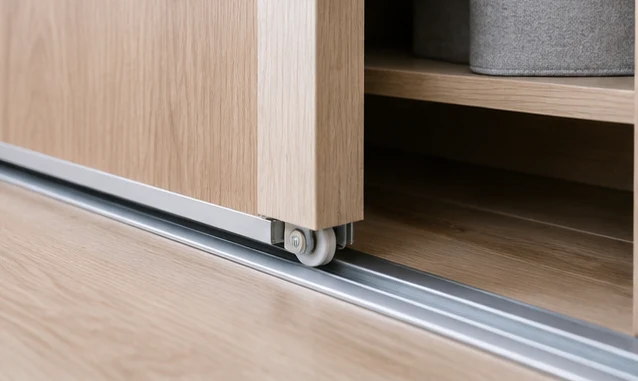
A sliding wardrobe door can become noisy for weeks before it suddenly jams or leans out of its opening. The visible problem may be at the bottom, but the cause could be a loose upper guide, a damaged wheel or a track that is no longer supported evenly. Forcing the panel along can turn a replaceable hardware fault into a bent rail or broken mirror. Start by taking the affected door out of use and identifying the system. The useful question is not whether sliding doors are a good choice, but which part of this particular assembly has stopped controlling the panel.
Make the panel safe before investigating
Keep children and pets away from a leaning or unstable door. Do not try to catch a heavy panel by its edge or pull it outward to see underneath. Mirrored and glazed doors are especially awkward because their weight and fragile surfaces make improvised handling unsafe. Arrange supported removal by someone familiar with the system if the door has partly disengaged.
Take photographs of the whole opening, the lower corners and any visible brand marks without moving an unstable panel. These pictures help distinguish a bottom-running door, whose lower wheels carry the weight, from a top-hung arrangement. The repair sequence differs, so generic instructions to lift the door out are not reliable.
Separate dirt in the rail from failed hardware
With the panel safely retained, look for a small obstruction in the accessible track. Grit, hair and loose screws can interrupt a wheel and make a healthy door feel damaged. Vacuum accessible debris using a brush attachment rather than dragging a sharp tool through the running surface. Stop if cleaning requires putting fingers beneath the panel.
A repeated bump at the same place suggests a local obstruction or damaged rail. A rumble throughout travel can indicate a worn wheel. A door that travels smoothly but sits crooked may need an alignment check. These are clues rather than proof: the fitter should also inspect the guide engagement, track fixings and supporting cabinet before selecting parts.
Check rollers, guides and retention devices together
Roller assemblies contain more than a visible wheel. The housing, bearing, adjustment screw and attachment to the door all matter. A wheel may still turn while its housing has cracked, or the adjustment thread may have stripped so the corner slowly drops again after being raised. Repeated adjustment will not repair either fault.
Upper guides and anti-jump devices keep the panel engaged with its intended path. They must be present and set according to the hardware instructions, not removed because they scrape. Where one roller has failed, ask whether the manufacturer recommends replacing a matched pair. Mixing different wheel diameters or profiles can leave the door leaning even when the new component appears to fit.
Decide whether the track is repairable
A loose but undamaged track may be capable of being refixed once its support and fixing holes have been assessed. A crushed running ridge, sharp kink or heavily worn channel usually needs a compatible replacement rather than hammering into shape. Even a small distortion can repeatedly throw the same door off line.
The fitter should check whether the bottom rail follows a dip in the floor or has been distorted by uneven tightening. Packing and support must suit the track system. At the top, loose cabinet framing can let guides move apart. Repairing the supporting joinery is sometimes essential before new wheels will behave properly, particularly where the opening has changed shape since installation.
Identify replacements before dismantling
Keep any labels, fitting instructions and original purchase information. Useful measurements include the roller housing dimensions, fixing centres, wheel profile and rail cross-section. These should be taken after safe access has been arranged, not by balancing a disconnected door against a wall. Similar-looking hardware is not necessarily interchangeable.
Availability may determine whether an individual roller, a complete hardware set or both track and running gear need replacement. Ask the repairer to explain the compatibility decision. An improvised wheel can alter guide engagement and door overlap. If the original system cannot be identified, a coherent replacement system may be more sensible than combining unrelated parts, provided the existing panels are suitable.
Test the repair under normal use
Before the visit, note whether the fault began after cleaning, moving furniture or work on the floor. Mention any impact to the frame and whether both panels are affected. These details can point towards a shared support problem rather than two simultaneous wheel failures. Leave any loose components in a labelled container and avoid discarding broken plastic pieces: their shape may identify the original retention system. If the wardrobe is still accessible from another panel, use it only where doing so does not disturb the unstable door. Agree safe access with the repairer first.
After refitting, each panel should move through its full travel without rubbing, jumping or exposing a loose edge. Check the overlap between doors, the engagement of guides and the operation of stops and any soft-close catches. Closing force should not be used to conceal poor alignment. A mirrored panel should remain securely held in its frame.
Ask what routine care the particular track needs. Some systems run dry; others specify a particular lubricant at a particular point. Spraying oil into an unidentified rail can collect dirt or affect nearby materials. Keep the hardware reference with household records so a future repair does not begin with the same identification problem.
Questions we're asked about this
Need a sliding wardrobe fault assessed?
Send photographs of the opening, visible hardware and any maker’s label, and describe where the panel catches or leaves its track.
Get a free quote
Reply within 24 hours - No obligation