
Problems & repairs
Timber gate bracing: repairing a frame that racks
A diagonal is useful only when the frame can carry its forces.
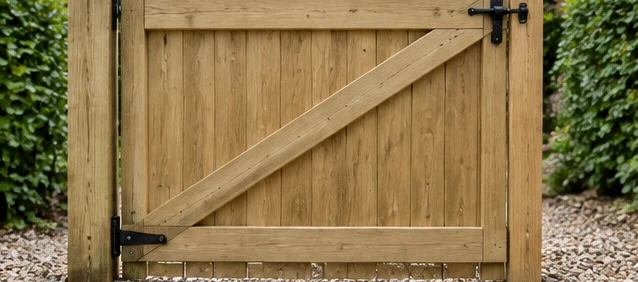
A rectangular gate frame can change shape without any individual rail becoming shorter. Its corners rotate, the free end drops and the rectangle becomes a parallelogram. That distortion is racking. A properly designed diagonal helps resist it, but screwing another piece of timber across a damaged frame does not automatically restore the structure. This guide focuses on the frame and brace once the supports are known to be sound, rather than repeating a general diagnosis of dragging gates.
Why a rectangle needs help to stay square
Imagine the rails and stiles joined by corners that can pivot slightly. The frame can lean sideways even though all four members retain their original lengths. Real timber joints are not simple pivots, but wear, shrinkage and repeated loading can allow enough movement to produce the same effect. The gate may then miss its keep even with an upright hanging post.
A diagonal divides that flexible outline into triangles, whose geometry resists changes of shape more effectively. This principle explains why a brace is structural rather than decorative. It also explains its limitations: the diagonal has to transfer force into members and joints that are capable of receiving it. If the rail end is split or the stile is soft, the apparent triangle contains a failing connection. Adding timber over it can hide the defect while leaving the underlying movement unresolved.
Identify compression bracing by the hinge side
For a conventional timber compression brace, the diagonal rises from the lower hinge side towards the upper free corner. When the free corner tries to drop, the brace works as a strut, transferring that tendency back towards the lower hinge region. Describe it relative to the hinges rather than saying it slopes left or right, because that changes with the face being viewed.
This rule concerns the intended compression member, not every visible diagonal on every gate. A tension cable works differently and normally runs from the upper hinge region to the lower free corner. Engineered frames and proprietary bracing systems may use other arrangements. Do not reverse a timber brace merely to match a photograph of a cable kit. Identify the construction and follow its design; the appearance of a diagonal alone does not tell you how it is supposed to work.
Check bearing and joints before adding fixings
A compression brace needs effective bearing at its ends so the compressive force can enter the frame. A loosely fitted diagonal held only by a few screws through thin boarding does not necessarily create that load path. Inspect the contact areas, the adjacent rails and the joints connecting those rails to the stiles. The whole arrangement matters more than the number of visible screw heads.
Look for crushed fibres, open shoulders, splits near fasteners and areas where the brace has slipped. Check whether the boarding is intended to contribute to the construction or is simply cladding. Do not assume that the boards can replace a defective frame joint. Where the original gate uses a particular joint or bracing detail, establish how it was meant to work before changing it. Extra screws can split a narrow rail and make a repair less reliable, rather than more secure.
Decide whether the existing frame can be squared
Local repair is most plausible when the principal members remain sound and the joints can be restored to their intended positions. The leaf generally needs to be removed and supported on a stable working surface so its geometry can be assessed without hanging loads. A heavy gate needs a suitable handling plan; lifting it by the brace is not an appropriate shortcut.
Corner to corner measurements help reveal distortion in a rectangular frame, but equal diagonals alone do not prove every joint is sound or the leaf is flat. Check the intended outline, straightness and twist as well. If the frame can be brought square without forcing damaged members, a properly fitted replacement brace and repaired joints may be reasonable. If it springs back, has widespread joint damage or relies on rotten timber, the scope is more than adding a diagonal.
Know when a repair becomes redesign
A replacement brace that repeats a sound original detail is different from altering the gate's structural scheme. Moving rails, changing the hanging side, adding heavy boarding or extending the leaf changes how forces travel through it. Those alterations need a coordinated design, not an assortment of brackets chosen after each new movement appears.
Cable kits and metal straps can have legitimate applications when selected and installed for the particular gate. They are not universal cures for failing timber joints, and overtensioning can distort a leaf that was previously flat. Likewise, a large new timber strut may add weight without providing useful bearing. If substantial parts of the frame need replacement, consider rebuilding the leaf to a suitable construction while retaining sound reusable hardware where appropriate. That makes the repair boundary explicit instead of disguising a redesign as a small reinforcement.
Verify geometry before resetting the latch
Complete the frame work and allow any specified adhesive or coating stages to finish before rehanging. Check the restored leaf against its supports and hardware without using the latch to pull it square. The gate should move through its swing without the repaired frame changing shape under ordinary operation. Small hardware adjustments may follow, but they should not conceal renewed racking.
Record the work at the brace ends and frame joints before any boarding or finish obscures it. Agree which components were retained and whether the gate's original appearance has changed. If the gate still does not sit correctly, stop and distinguish remaining frame distortion from a separate support or hinge issue. The successful outcome is not merely a diagonal that points in the expected direction; it is a leaf whose joints, brace and mounting arrangement can work together without forcing the closure.
Questions we're asked about this
Assess the frame before reinforcing it
For a gate frame repair enquiry, include a full view of the braced face and close photographs of both brace ends and the rail to stile joints.
Get a free quote
Reply within 24 hours - No obligation