
Property types & audiences
Internal door stops and finger-trap safety in family homes
Protecting a wall and protecting small fingers are different jobs.
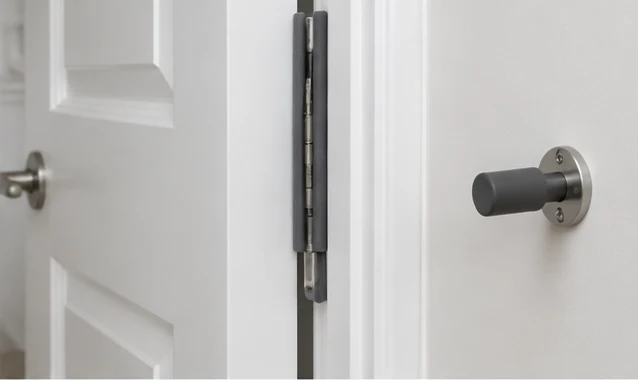
A rubber-tipped stop can keep a handle out of the plaster without preventing a door from closing on a hand. That distinction matters when adapting ordinary internal doors for family life. Opening limiters, hold-open devices, anti-slam products and hinge guards address different movements and different trapping points. Rather than buying one of each, look at how each doorway is used, where children put their hands and what adults need to operate easily. No accessory makes a doorway childproof or removes the need for supervision; careful selection can nevertheless address specific, avoidable hazards.
Map the two trapping sides
The closing edge is the familiar risk: fingers can sit between the leaf and its frame as the door shuts. The hinge side is less obvious. Opening a hinged leaf creates a changing gap near the pivot, which narrows again when someone closes it from the other side. A child may be out of sight of the person using the handle.
Walk through the home at a quiet time with children elsewhere. Identify doors beside play areas, opposing bedroom doors and openings where siblings follow one another. Do not demonstrate trapping with a hand or ask a child to test a device. The British Association of Plastic and Reconstructive Surgeons identifies closing doors and hinges as causes of serious fingertip injury and advocates suitable preventative devices.
Choose a stop for opening travel
A fixed wall or skirting stop limits how far a door opens. Positioning depends on the handle projection, nearby furniture and the shape of the leaf. Its buffer should meet a suitable part of the door before the handle strikes the wall. A stop that is too short, or mounted on weak trim, may fail at precisely that task.
Floor-mounted stops can solve awkward wall arrangements but introduce something into the walking and cleaning route. Consider bare feet, vacuuming, wheeled aids and the likelihood of tripping. Before any drilling, identify concealed services, including heating below the floor. Do not fasten through a floating floor in a way that pins it down. Where the proposed fixing is uncertain, change the location or obtain a suitable installation detail.
Understand what anti-slam products actually prevent
A removable device placed on an ordinary door edge may keep that leaf from closing fully while the device is correctly fitted. That can address closing-edge trapping, but it does not automatically cover the hinge gap. Check the manufacturer's intended location, door thickness range, permitted opening conditions and instructions for removal.
Do not assume the same accessory fits every leaf. A product can slide, wear or be displaced during play. Loose wedges and detached parts should not be left where young children can handle or mouth them. Avoid improvised arrangements made from small objects or tied cords. The relevant question is not whether the door feels softer once, but whether the product stays securely in its intended position during the way that particular doorway is used.
Consider hinge guards separately
A purpose-made hinge guard covers access to a moving hinge-side gap. Products differ in the hinge arrangements, opening angles and door sizes they accommodate. Some guard one face only; inspect the doorway from both sides rather than assuming the reverse gap has disappeared. Follow the exact product instructions and ask the supplier about compatibility if the geometry is unusual.
A guard must move freely through the intended arc without peeling away, binding or exposing a reachable gap at its ends. Adhesive fixing depends on a suitable clean surface and the specified preparation. Screw-fixed versions need appropriate fixing positions. Neither is improved by guessing. If the door has a closer, specialist hinges or another controlled function, obtain advice before adding accessories or altering its travel.
Keep adult operation and routes straightforward
A device that makes a doorway awkward can create a different problem. Adults should be able to understand its operation and move through without stepping over loose objects. Check the arrangement while carrying laundry, guiding a child or using a mobility aid. Products intended to hold a door open must not be used where the door is required to remain closed.
Think about night-time routines too. A stop should not narrow a landing route or leave a protrusion where someone walks in low light. A child who can reach the handle may also reach accessories placed nearby. Reassess the arrangement as their reach and behaviour change. Safety equipment supports supervision; it should not encourage leaving children unattended around moving doors or relying on siblings to manage the risk.
Use a simple inspection routine
After fitting, operate the door slowly through its complete intended movement while keeping hands away from all gaps. Confirm that the stop contacts correctly, fixings remain firm and guards follow the motion without stretching or lifting. Check any closure-prevention accessory in the position specified by its manufacturer, rather than repeatedly slamming the leaf as a test.
Repeat the checks after decorating, new flooring or changes to hinges and handles. These can alter clearance or prevent an adhesive product from sitting correctly. Replace split buffers, loosened guards and worn components rather than disguising them with extra tape. Keep fitting instructions where other carers can find them and explain the purpose of each device. A consistent arrangement is easier to use correctly than a collection of improvised fixes.
Questions we're asked about this
Check the doorway before choosing accessories
Provide photos of both hinge faces, the open door and its nearby wall to discuss stop positions and any door adjustment needed before accessories are selected.
Get a free quote
Reply within 24 hours - No obligation