
Planning, process & cost
Radiator covers: planning airflow and access before the cabinet
Start with the heating appliance, not a decorative grille.
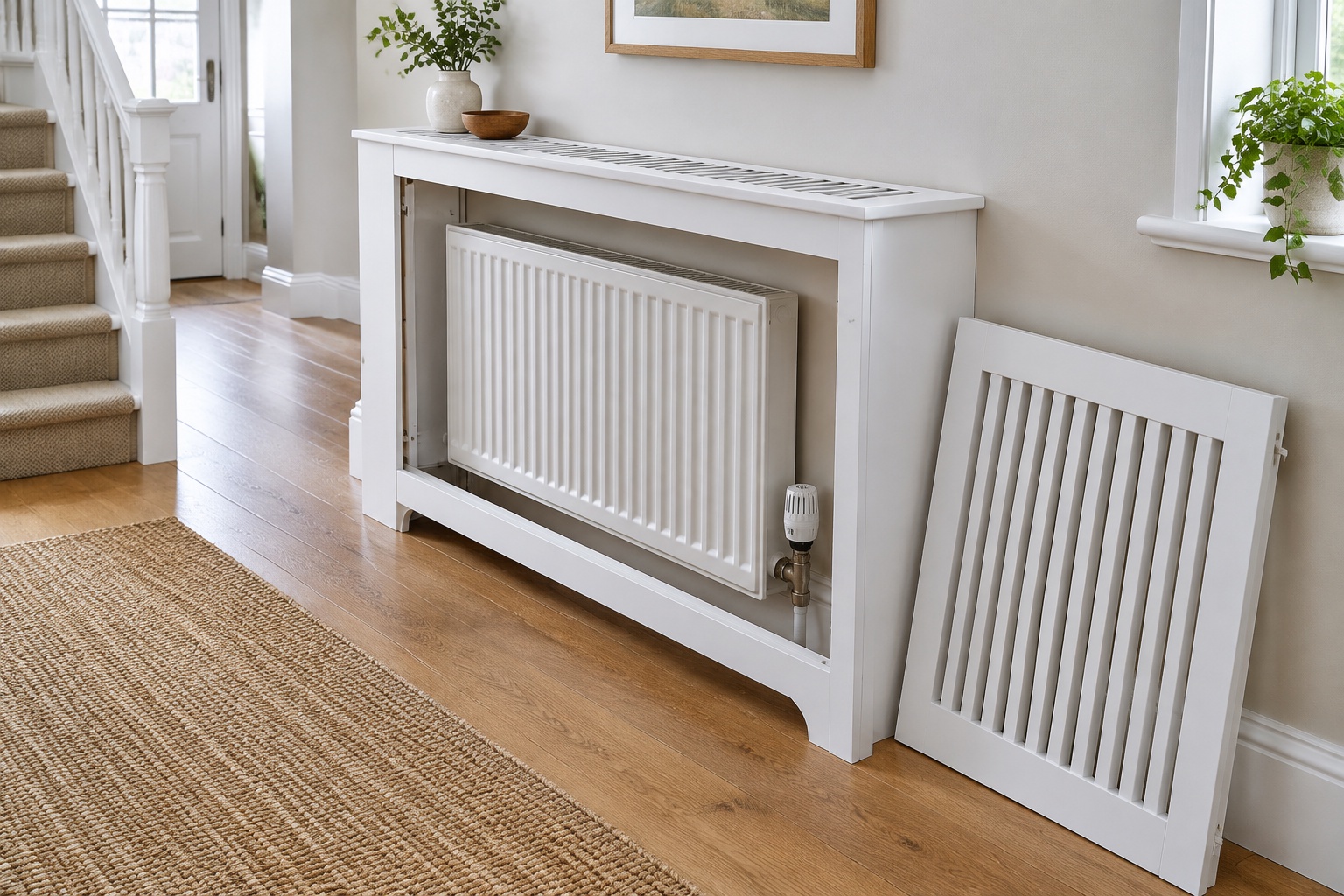
A custom radiator cover is a cabinet enclosure around heating equipment, so its suitability depends on more than matching the skirting. It can change how heat enters the room, how a thermostatic valve senses temperature and how easily the radiator can be serviced. Start by identifying the appliance and consulting its manufacturer's instructions. Some heating products must not be covered or enclosed. No grille pattern or general clearance rule makes an unsuitable enclosure acceptable, and a heating professional may need to assess the proposal before joinery is designed.
Identify exactly what would be enclosed
Record the make and model where possible, the heat source, the valve arrangement and the position of any controls. Do not assume that instructions for a water-filled radiator apply to electric panel heaters, storage heaters or other appliances. If the equipment cannot be identified, obtain advice rather than designing around its external dimensions alone.
Read the appliance instructions for restrictions on covers, surrounding materials, ventilation and maintenance. If enclosure is prohibited, change the furniture proposal instead of attempting to compensate with larger holes. Where instructions are unclear or unavailable, ask the manufacturer or a suitably qualified heating professional to assess the specific appliance and proposed arrangement before the cabinet detail is approved.
Assess the room heating requirement first
Tell the heating professional whether the room already struggles to warm up or has uneven temperatures. An enclosure may alter heat delivery, so an existing shortfall should not be hidden by decorative work. Record furniture positions, curtains and any other obstructions that influence the radiator's performance. This provides context for judging whether a cover is appropriate at all.
Do not assume that an open-looking front preserves the original heating output. Air paths, surrounding surfaces and the appliance design interact. Any proposed changes to the radiator, valves or heating system should be assessed separately from the joinery. A cabinet design is not a substitute for investigating a radiator that remains cold, leaks or makes unusual noises.
Draw the whole airflow route
Where enclosure is permitted, show how room air can reach the appliance and how warmed air can leave. The base, front and top need to be considered together against the manufacturer's requirements and professional advice. A decorative perforated panel may look open while a solid plinth or internal rail constricts the intended route.
Include the real grille construction, frame thickness and internal supports in the assessment. Do not treat the outside size of a grille as its unobstructed opening area. Check how curtains, nearby furniture and objects placed on top could interfere with the arrangement. Agree the intended use of the cabinet so a ventilation opening does not become an attractive place to stack books.
Keep thermostatic controls able to sense the room
A thermostatic radiator valve enclosed in a warm pocket may respond to conditions inside the cabinet rather than the occupied room. That can affect how the radiator operates. Show the valve position and access on the proposal and ask a heating professional whether the control arrangement is suitable, including whether an appropriate alternative sensing arrangement is needed.
Do not relocate, extend or adjust heating controls simply to make the cabinet symmetrical. Any alteration must be compatible with the system and carried out by an appropriate person. The user should be able to see and operate ordinary controls without reaching awkwardly beside hot surfaces. Keep labels and operating information available rather than burying them behind permanent trim.
Plan access for bleeding, isolation and leaks
Identify the bleed point, both valves and pipe connections before drawing the cabinet divisions. Routine access may be needed in more than one place. Small decorative openings that admit a hand do not necessarily provide space for tools, visibility or safe working. Ask the heating professional what access is required for the actual appliance and fittings.
Consider a leak as well as planned maintenance. The enclosure should not make it needlessly difficult to notice water, reach isolation points or inspect the floor beneath. Avoid storage compartments containing belongings beside valves or pipe joints. If access depends on removing a panel, the removal method should be straightforward and understood by the household.
Make removal practical, not merely possible
A removable front is useful only if it can be released and lifted clear with the cabinet in its finished position. Check the route past skirting returns, nearby furniture and projecting valves. Heavy panels, hidden fixings or a top that must be dismantled first can turn a simple service visit into a joinery job.
Plan for eventual radiator removal or replacement, not just access to the valve heads. Agree which cabinet parts come away and whether decorating joints would be broken. The enclosure still needs suitable restraint against accidental movement during normal use. Hardware selection should balance secure fitting with the intended maintenance procedure rather than relying on a loosely propped decorative screen.
Select materials and finishes for the assessed conditions
Discuss expected heat exposure with the heating professional and check the suitability of proposed materials, adhesives, grilles and finishes with their suppliers. Do not choose a finish solely because it matches another cupboard. Repeated heating can affect components differently, and the appliance instructions may restrict nearby materials or the enclosure arrangement altogether.
A cover must not be presented as a guarantee against burns or other injury. Surface temperatures and accessible openings depend on the system and design. Consider who uses the room, including children and people with reduced sensation or mobility, and seek appropriate advice about those risks. Do not add a cushion or treat the top as a seat unless that use has been specifically assessed.
Record the agreed limits and check after installation
Keep the appliance information and the approved enclosure drawing together, including the required openings, removal method and access points. Avoid substituting a denser grille or closing a gap during decoration without checking the implications. There is no universal fixed clearance that can be copied safely between different appliances and cabinet designs.
After installation, arrange any checks recommended by the heating professional and observe how the room and controls behave in normal use. Report poor heating, unexpected heat build-up or operating problems rather than modifying the enclosure by guesswork. Keep ventilation routes unobstructed, remove accumulated dust as instructed and reassess the arrangement whenever the appliance or controls are changed.
Questions we're asked about this
Considering a custom radiator enclosure?
Include the appliance instructions and heating professional’s advice when asking us to assess the proposed cabinet enclosure.
Get a free quote
Reply within 24 hours - No obligation