
Planning, process & cost
Checking for hidden pipes and cables before wall fixings
A quiet detector is not proof that a drilling position is clear.
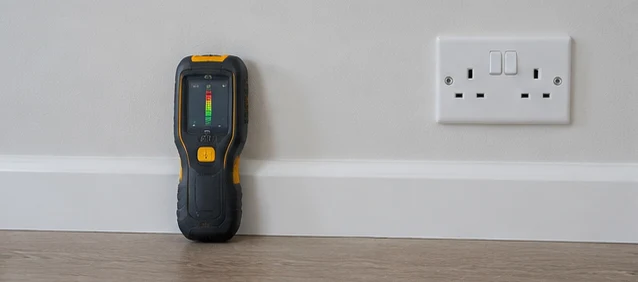
Shelves, cabinets and wall features all need attachment points, but the surface usually reveals little about the services behind it. A pipe may take an unexpected route after an alteration; a cable may remain behind a redundant fitting; a detector may respond differently across layers of plaster, metal or insulation. The task is to manage uncertainty before choosing a fixing position, not to obtain a reassuring beep and start drilling. This guide covers the planning checks and their limitations. It does not explain electrical testing, opening electrical accessories, isolating circuits or repairing damaged services: those tasks require appropriate professional competence.
Start with the building information you already have
Look for service drawings, photographs taken before walls were closed and records from previous alterations. These can identify likely routes and explain unusual construction. Check when they were produced and whether later work may have changed the arrangement. A drawing is useful evidence, but it should not be treated as an exact map of every pipe and cable in the current wall.
Explain the proposed fixings to the installer, including their locations, intended depth and the object being supported. A heavy cabinet cannot simply be moved to any convenient clear spot if its support system requires particular positions. Coordinating the structural attachment and service checks early gives more options than discovering a conflict after the joinery has been made.
Be especially cautious where the wall contains several layers added at different times. A detector response may relate to one layer while the proposed fixing extends into another. Decorative boards and existing furniture can also limit access for assessment. Tell the installer about these restrictions rather than assuming that a check of the nearest exposed patch represents the entire fixing area.
Read visible clues without turning them into guarantees
Sockets, switches, radiators, taps and visible pipe entries provide context. Consider the other side of a partition and the rooms above and below, where safely accessible. A bathroom behind the proposed shelf or a heating connection near the floor may justify more investigation. Visible clues should widen the assessment, not be used to draw an optimistic clear patch around a drill mark.
Electrical installations have recognised cable-routing zones, but being outside an expected route does not prove that no cable is present. Older work, alterations or non-compliant installation can produce surprises. Equally, an apparently unused outlet may not mean that all associated wiring has been removed. Do not remove faceplates or disturb fittings to investigate; ask a qualified registered electrician where electrical uncertainty remains.
Use detectors as one part of a competent assessment
Detection equipment has different capabilities. A tool intended to locate metal does not necessarily distinguish a water pipe from another metal object, and an electrical detection mode is not a general pipe detector. Read the device instructions for supported materials, operating conditions, calibration and detection depth. A single advertised depth figure is not a promise of performance through every wall build-up.
Foil-backed materials, metal lath, reinforcement, moisture and layered construction can complicate responses. Non-metallic pipes may not be detected by equipment intended for metal. Electrical detection can also depend on the technology and conditions specified by the manufacturer. The important conclusion is that a negative reading reduces neither every uncertainty nor the need for other checks. Where the wall defeats reliable assessment, stop rather than repeatedly scan until a preferred answer appears.
Keep the proposed fixing area under review
A fixing involves more than its pencil mark. Drill diameter, depth, angle, the plug or anchor and the eventual screw all form part of the operation. Long fixings can reach beyond the layer the installer intended to use. Check the complete proposed arrangement against both the support requirement and the information available about concealed services.
Changing the bracket, adding another screw or moving a rail can invalidate an earlier check. Keep any agreed restrictions visible and tell everyone carrying out the work. If the installation needs more attachment points than first expected, reassess them before drilling. The desire to finish a nearly completed cabinet run is not evidence that an extra fixing is safe.
Stop when the evidence does not agree
Conflicting detector responses, missing records or a likely service route through the required support area are reasons to pause. HSE guidance on work near electricity emphasises planning, locating services and working away from wiring wherever possible. Its concealed-services guidance also warns about uncertainty before drilling. Ask the appropriate competent professional to resolve the risk rather than using a short exploratory drill hole.
Any electrical isolation, proving dead, investigation or relocation should be managed by a qualified registered electrician. Switching off a local switch does not establish that a wall is safe to drill, and an RCD is not permission to risk striking a cable. Water, heating and gas routes may need other appropriately qualified specialists. Moving an attachment point is useful only when the replacement position has also been assessed.
Agree how unexpected discoveries will be handled
If work exposes an unexpected service or suggests that something has been struck, stop immediately and keep clear of the affected area. Do not touch exposed conductors, investigate with a metal tool or conceal suspected damage behind the fitting. Arrange the appropriate professional or emergency response according to the hazard. A service can be damaged without an obvious immediate loss of function.
After the installation, retain records of confirmed routes and any agreed no-fixing areas, while making clear how they were established. Photographs taken during authorised open-wall work can help future planning but should not become a blanket guarantee for the whole wall. The lasting benefit is a documented, cautious process: suitable support, informed service assessment and a clear point at which uncertainty stops the job.
Questions we're asked about this
Planning substantial wall-mounted joinery?
Provide available service records and proposed fixing positions early, so unresolved routes can be assessed before the installation starts.
Get a free quote
Reply within 24 hours - No obligation